Why fall and winter can be a smart time to list, and when waiting really does make sense.
By Jon Campbell · Jon Campbell Team
The short answer
Not necessarily. Spring brings the most buyer traffic, but it also brings the most competing listings. Fall offers lower inventory and serious buyers who want to move before the holidays, and winter is when many investors are actively buying before the year ends. The right time to sell depends on your goals, your next move, and your home, not just the calendar.
It’s one of the most common questions we hear once the leaves start turning: “Should we just wait until spring to list?” It makes sense. Spring has a reputation as selling season, and nobody wants to leave money on the table. But in the Lehigh Valley, fall and winter can work in a seller’s favor in ways a lot of homeowners don’t expect.
Jon breaks it down in under a minute:
Jon Campbell on why fall and winter can be a smart time to sell.
SpringMost buyer traffic, but also the most competing homes for buyers to compare yours against.
FallFewer listings, motivated buyers, and a real push to close before the holidays.
WinterInvestors shopping before year-end, plus relocation buyers with firm start dates.
Is spring really the best time to sell a house in the Lehigh Valley?
Spring does bring more buyers out. Open houses are busier, online searches pick up, and families try to line up a move with the end of the school year. That traffic is real.
What often gets left out is that sellers think the same way. When a lot of homeowners wait for spring, they all list at once, and buyers suddenly have more options to compare. More traffic doesn’t automatically mean a better result for your home if three similar houses on nearby streets hit the market the same weekend.
Why can fall be a good time to sell?
Fall is when inventory tends to thin out. Plenty of sellers decide to “wait until spring,” which means the homes that are on the market get more attention from the buyers who are still looking. And the buyers who are still looking in October and November are usually serious:
Renters whose leases end over the winter
People starting new jobs or relocating to the area
Buyers who lost out on homes over the summer and are ready to act
Families who want to be settled in before the holidays
The local market is also still strong heading into fall. According to Greater Lehigh Valley REALTORS, the median sales price in Lehigh and Northampton counties rose 9.2% year over year to $379,000 in August 2026, and closed sales were up 3.2%. Inventory rose to 893 homes, but supply is still well below the roughly six months generally considered a balanced market. In other words, buyers are still competing for a limited number of homes.
Is winter a bad time to sell a house?
Not for every home, and for some properties it can be one of the best times. Winter is when many real estate investors are actively shopping. Investors often want to close before the year ends for tax planning, to put capital to work before January, or to meet deadlines on a 1031 exchange from a property they sold earlier in the year.
That makes late fall and winter an especially good window if you own:
A rental property or multi-family home
A house that needs updating or would suit a flip
An inherited property you’re ready to move on from
Winter also brings relocation buyers with firm January start dates, and people who are house-hunting in December generally aren’t browsing for fun.
This isn’t tax advice. Investors should talk with a tax professional about their own timing.
What do I risk by waiting until spring?
Waiting isn’t free, and it isn’t guaranteed to pay off. A few things to weigh:
More competition. Your home will likely be one of many new listings.
Unknowns. Nobody can promise where mortgage rates or prices will be in six months.
Carrying costs. Another season of mortgage payments, taxes, insurance, heating, and winter upkeep.
Your plans on hold. If you’re ready to buy your next home, waiting on the sale can mean waiting on that too.
When does it make sense to wait until spring?
Sometimes spring really is the better call, and we’ll tell you when it is. Waiting may make sense if:
Your home’s biggest selling point is outdoors, like a pool, gardens, or a big yard
You have repairs or updates you can finish over the winter
You’re timing a move around the school year
You have no deadline and no next home lined up yet
How do I get my home ready to sell in fall or winter?
A few simple steps make a big difference in the colder months:
Turn on every light and open the blinds for showings, since days are shorter
Schedule listing photos for the middle of the day to catch the best natural light
Keep walkways, steps, and the driveway clear and safe
Make the home feel warm and comfortable, with the heat set a little higher for showings
Keep holiday decorations light so buyers can picture their own
Price it right from the start, because serious off-season buyers know the market
How do I decide whether to sell now or wait?
Start with real numbers. Find out what your home is worth today, then talk through what selling now versus in spring would look like for your situation. Our team can also walk you through options like our Guaranteed Sale, Immediate Buyout, and Get Paid Twice programs if timing or certainty is your biggest concern.
Thinking about selling this fall or winter?
See what your home is worth in today’s Lehigh Valley market, then let’s talk timing.
Market data: Greater Lehigh Valley REALTORS, August 2026 (Lehigh and Northampton counties). Jon Campbell Team | Real of Pennsylvania | 95 Highland Ave Suite 130, Bethlehem, PA 18017 | 610-756-2090
What Is My Lehigh Valley Home Worth? (And Why the Zestimate Is Often Wrong)
By Jon Campbell, Team Leader, Jon Campbell Team | Real · Last updated July 2026 · 6 min read
Key takeaways
Automated estimates like the Zestimate rely on public records and averages, and cannot account for condition, updates, or the newest comps.
An accurate value comes from a comparative market analysis of recent sales of similar homes in the same area and condition.
Location and school district, condition, recent comps, and current competition are the four factors that move a home’s value most.
Almost every homeowner has typed their address into a website to see an instant “value.” It’s a fine starting point — but if you’re actually thinking about selling, that number can be off by thousands in either direction. Here’s how home value really works, and why the online estimate isn’t the whole story.
How online estimates work — and where they break
Automated valuation models (the “Zestimate” and similar tools) crunch public records and recent sales to produce an estimate. They’re useful for a rough ballpark, but they share the same blind spots:
They can’t see inside your home — updates, condition, and finishes are invisible to an algorithm.
They lean on averages that miss micro-differences between blocks and school districts, which matter enormously in the Lehigh Valley.
They lag the market, so in a fast-moving area the estimate can trail current reality.
They don’t know about that new kitchen, the finished basement, or the busy road behind the house.
How value is actually determined
A real valuation starts with a comparative market analysis: recent sales of genuinely similar homes — same area, similar size and condition, sold in the last few months — adjusted for the specific features of your property. In a market where homes sell at roughly 101% of list, getting this right is the difference between a fast, strong sale and a listing that stalls.
The factors that move your number most
Location and school district. A home in Emmaus’s East Penn district carries a different premium than a similar home a few miles away.
Condition and updates. Move-in-ready homes are winning as inventory rises.
The most recent comps. Sales from the last 60–90 days carry the most weight.
Current competition. What else is on the market at your price point right now.
Why it matters more than ever
With buyers taking more time to compare, pricing off a stale or inflated online estimate is risky. Price too high and you burn your best two weeks of buyer attention; price too low and you leave money on the table. An accurate, current valuation protects you on both ends.
An online estimate answers “roughly what might this be worth?” A professional valuation answers the question that actually matters: “what will a buyer pay for this home, right now?”
If you’re even considering a move, it’s worth getting a real number. Our valuation is free, uses live local data, and comes with a human read on your specific home — no obligation attached.
Get a real valuation, not an algorithm’s guess
Our free home valuation uses current Lehigh Valley comps and a human eye on your home.
Why is my Zestimate different from my home’s actual value?
Online estimates rely on public records and averages and can’t see your home’s condition, updates, or exact location advantages. They also lag a fast-moving market. That’s why they can be off by thousands compared with a professional valuation using current local comps.
How do I find out what my home is really worth?
The most accurate method is a comparative market analysis: recent sales of similar homes in your specific area and condition, adjusted for your home’s features. A local agent can prepare this and account for details an algorithm can’t see.
What affects my home’s value the most?
Location and school district, the home’s condition and updates, the most recent comparable sales in your area, and current competition at your price point are the biggest factors. In the Lehigh Valley, micro-differences between blocks and districts matter a great deal.
Market data: Greater Lehigh Valley Realtors (GLVR), 2026, covering Lehigh & Northampton counties. Figures move month to month — verify current numbers before republishing.
Should I Rent or Buy Right Now? A Lehigh Valley Reality Check
By Jon Campbell, Team Leader, Jon Campbell Team | Real · Last updated October 2026 · 9 min read
Key takeaways
Buying builds equity two ways: you pay down your loan, and the home appreciates. The Lehigh Valley median sale price was $375,000 in September 2026, up 6.8% from a year earlier, after hitting a record $390,000 in July (GLVR). Rent builds equity for your landlord, not you.
Rates above 7% make buying more expensive month to month, but buyers now have more homes to choose from: inventory is up 10.8% to 963 homes.
You almost certainly don’t need 20% down. Conventional loans go as low as 3% down, FHA 3.5%, and VA and USDA loans can be 0% down for those who qualify. Pennsylvania’s PHFA programs, such as Keystone Advantage (up to $6,000) and K-FIT (5%, forgiven over 10 years), can cut the cash you need further.
It’s the question almost every renter in the Lehigh Valley is weighing right now. Mortgage rates have climbed back above 7%, and home prices are still higher than a year ago. Does it still make sense to buy, or is renting the smarter play? The honest answer is that it depends on your timeline and your situation. But the case for buying is stronger than the headlines suggest, and the biggest thing standing in most people’s way, the down payment, is smaller than they think.
Jon put this exact question to ChatGPT, then explained what it missed:
Jon Campbell on renting vs. buying in the Lehigh Valley in 2026.
Renting isn’t “throwing money away,” but it isn’t building anything either
Let’s be fair to renting. It’s flexible, it comes with no maintenance costs, and in the short term it’s often cheaper month to month. If you value being able to move easily, renting earns its keep.
Here’s what matters over time, though. Every rent check is gone the moment you pay it, and rent tends to rise every year. A mortgage payment works differently: part of every payment goes toward your loan balance, which comes back to you as equity. Meanwhile, the home itself has historically gone up in value. In the Lehigh Valley, the median sale price rose from $351,000 in September 2025 to $375,000 in September 2026 (GLVR). That’s a $24,000 increase in one year. A renter captured none of it. An owner captured all of it.
What 7% rates change, and what they don’t
Higher rates are real, and we won’t pretend otherwise. Freddie Mac’s 30-year fixed rate averaged 7.40% as of October 15, 2026, up from 6.49% in early July. Here’s what that does to principal and interest on a median-priced home with 3.5% down:
$375,000 home, 3.5% down ($361,875 loan)
30-year rate
Monthly principal & interest
Early July 2026
6.49%
about $2,285
Mid-October 2026
7.40%
about $2,506
Principal and interest only. Taxes, homeowners insurance and mortgage insurance add to the monthly cost and vary by home and loan. Illustration, not a loan quote.
That’s roughly $220 a month more, and it’s why GLVR’s housing affordability index fell from 110 to 97 over the past year. But two things haven’t changed:
Buyers have more choices. Lehigh Valley inventory rose 10.8% to 963 homes in September, and homes are taking slightly longer to sell. More options means more room to negotiate on some homes, including seller-paid closing costs or a rate buydown.
You can refinance a rate, but not a purchase price. If rates come down later, owners can often refinance into a lower payment. Nobody can refinance into the price a home sold for a year earlier. Refinancing depends on your credit, equity and costs at the time, so there are no guarantees.
Where the equity actually comes from
When people say buying “builds wealth,” they’re describing two engines working at once:
Principal paydown (forced savings). Each monthly payment chips away at what you owe. Early on it’s a little; over the years it becomes a lot. It’s savings you barely notice you’re doing.
Appreciation. If your home rises in value the way Lehigh Valley homes have, that gain is yours. It’s also leveraged, because you earn it on the whole home’s value, not just your down payment.
Put simply, rent is an expense. A mortgage is part expense and part deposit into your own net worth. Give it a few years and the difference compounds in a way renting never can.
The down payment myth: you probably need far less than 20%
The biggest reason people assume they can’t buy is the belief that they need 20% down. On a $375,000 home, that’s $75,000, a genuinely intimidating number. But 20% isn’t a requirement. It’s just the threshold for avoiding private mortgage insurance. Most buyers put down far less:
Conventional loans: as low as 3% down. Programs like HomeReady and Home Possible are built for lower down payments, with reduced mortgage insurance for eligible buyers.
FHA loans: as low as 3.5% down. More flexible credit requirements, popular with first-time buyers.
VA loans: 0% down. For eligible veterans, active-duty service members and surviving spouses. No down payment and no monthly mortgage insurance.
USDA loans: 0% down. For eligible buyers in designated rural areas, which can include parts of the Lehigh Valley’s outer townships and surrounding counties.
On that same $375,000 home, 3.5% down is about $13,125. That’s still real money, but it’s a completely different conversation than $75,000, and that’s before assistance programs come in.
Pennsylvania-specific help: PHFA programs
This is the part many Lehigh Valley renters don’t know about. The Pennsylvania Housing Finance Agency (PHFA) exists to help people buy, and its programs can lower the cash you need at closing, sometimes dramatically:
Keystone Advantage Assistance: a 0% interest second loan of up to 4% of the purchase price, capped at $6,000, for down payment and closing costs, repaid over 10 years.
K-FIT (Keystone Forgivable in Ten Years): 5% of the purchase price or appraised value (whichever is less), with no dollar cap, forgiven at 10% a year over 10 years. On a $375,000 home, that’s $18,750. It’s paired with PHFA’s Keystone Home Loan or Keystone Flex first mortgages and is strong for buyers planning to put down roots.
HFA Preferred: a conventional loan with as little as 3% down and reduced mortgage insurance for eligible buyers. PHFA also offers a $500 grant toward closing costs with its HFA Preferred (Lo MI) option.
First Front Door: a FHLBank Pittsburgh program, offered through participating lenders while funds last, that matches what you contribute toward down payment and closing costs. Ask your lender whether it’s available and what the current match is.
Mortgage Credit Certificate (MCC): turns 20% of your annual mortgage interest into a federal tax credit, up to $2,000 a year, for as long as you keep the loan.
Most PHFA assistance requires a credit score of at least 660 and a homebuyer education course, and limits how much cash you can have left after closing. Eligibility also depends on income and purchase price limits, which vary by county and household size. Some programs require first-time buyer status (in PA, that means you haven’t owned a primary residence in the last three years), while others, like Keystone Flex, don’t. Because details change and not every program can be combined, the right move is to talk to a PHFA-approved lender who can run your specific numbers.
Between low-down-payment loans and PHFA assistance, the cash you actually need to get into a home is often a fraction of what renters assume. The barrier is usually information, not money.
When renting still makes sense
Buying isn’t automatically the right call, and we’d rather tell you that plainly. Renting is likely the better choice if:
You expect to move within the next two to three years. The upfront costs of buying need time to pay off.
Your income or job location isn’t stable yet.
You’re still paying down high-interest debt or building your credit and savings.
The monthly payment at today’s rates would stretch your budget, even with assistance.
You simply want maximum flexibility right now.
The rough rule of thumb: the longer you’ll stay put, the more buying wins. Over a short horizon, renting can come out ahead. Over five to ten years in an appreciating market like ours, ownership usually pulls clearly in front.
How to find out where you really stand
You don’t have to guess. Two quick steps give you clarity: get pre-approved with a lender so you know your real budget at today’s rates, and ask that lender specifically about FHA, conventional 3%-down, VA/USDA and PHFA assistance options. Many renters find they qualify to buy months or years before they thought they could.
This article is general information, not financial, tax or lending advice. Loan terms, rates and program details change and depend on your individual circumstances. Confirm current specifics with a licensed, PHFA-approved lender.
Wondering what you could actually afford?
We’ll connect you with a trusted local lender and show you what’s out there in your price range. Start with a quick, free conversation.
Is it better to rent or buy in the Lehigh Valley right now?
It depends mainly on how long you plan to stay. If you’ll be in the home for several years, buying usually wins because you build equity through principal paydown and appreciation while rents keep rising. The Lehigh Valley median sale price rose 6.8% to $375,000 in the year through September 2026, and owners captured that gain while renters did not. If you expect to move within two to three years, or your situation isn’t stable, renting may be the smarter choice.
Is it still worth buying a house with mortgage rates above 7%?
It can be, if you plan to stay several years and the payment fits your budget. Higher rates raise the monthly cost (about $220 more per month on a $375,000 home with 3.5% down at 7.40% versus 6.49%), but Lehigh Valley buyers now have more homes to choose from, with inventory up 10.8%. Owners may also be able to refinance if rates fall later, while the purchase price is locked in.
How much do I need for a down payment in Pennsylvania?
Far less than the 20% many people assume. Conventional loans can go as low as 3% down, FHA as low as 3.5%, and VA and USDA loans can be 0% down for those who qualify. On a $375,000 home, 3.5% down is roughly $13,125. Pennsylvania’s PHFA also offers down payment assistance that can reduce that further.
What programs help first-time buyers in Pennsylvania?
The Pennsylvania Housing Finance Agency (PHFA) offers several. Keystone Advantage provides up to $6,000 in down payment and closing-cost help as a 0% interest loan. K-FIT offers 5% of the purchase price that is forgiven over 10 years if you stay in the home. HFA Preferred is a low-down-payment conventional loan with reduced mortgage insurance, and a Mortgage Credit Certificate can turn 20% of your mortgage interest into a federal tax credit of up to $2,000 a year. Most require a 660 minimum credit score and homebuyer education, and eligibility depends on income and price limits, so confirm details with a PHFA-approved lender.
Market data: Greater Lehigh Valley REALTORS® (GLVR) Monthly Indicators, September 2026, Lehigh and Northampton counties. Mortgage rates: Freddie Mac Primary Mortgage Market Survey®, October 15, 2026. Program details: PHFA (phfa.org), October 2026. Terms change, so verify current specifics with a PHFA-approved lender before republishing. Jon Campbell Team | Real of Pennsylvania · 95 Highland Ave, Suite 130, Bethlehem, PA 18017 · 610-756-2090
Selling a House That Needs Repairs in the Lehigh Valley: Your Options
By Jon Campbell, Team Leader, Jon Campbell Team | Real · Last updated August 2026 · 6 min read
Key takeaways
You can sell a Lehigh Valley home that needs work three ways: repair then list, list as-is, or take a cash buyout.
An immediate cash buyout can close in as little as seven days with no repairs, showings, or commission.
Many ‘we buy houses’ investors offer only 50-60% of market value and may renegotiate after tying up the property.
Not every home is photo-ready, and that’s okay. Maybe you inherited a property that needs updating, maybe deferred maintenance has piled up, or maybe you simply don’t have the time or budget to renovate before selling. The good news: in a tight Lehigh Valley market, homes that need work still have real value — you just have to choose the right path.
Option 1: Fix it up, then list
If you have the time and capital, strategic repairs can pay off, especially since presentation increasingly separates listings in today’s market. But be selective. The goal isn’t a full renovation; it’s addressing the issues that scare buyers (roof, systems, major cosmetic problems) and the low-cost updates that photograph well. Over-improving rarely returns what you put in.
Option 2: Sell as-is on the open market
You can list a home in its current condition and let buyers factor repairs into their offers. In a seller’s market with roughly one month of inventory, as-is homes still attract interest — particularly from investors and buyers looking for value or a project. The trade-off is that you’ll typically field lower offers and may negotiate over inspection findings.
Option 3: Take an immediate cash buyout
If repairs, showings, and uncertainty are exactly what you’re trying to avoid, a cash buyout is often the cleanest exit. Our Immediate Buyout program provides a competitive cash offer with closing in as little as seven days — no repairs, no showings, no commission, and a closing date you choose. It’s a common choice for:
Inherited or estate properties that need work
Homes with deferred maintenance the owner can’t or won’t address
Tenant-occupied or distressed situations
Sellers who value speed and certainty over maximum price
Beware the “we buy houses” trap
Not all cash offers are equal. Many so-called investors and wholesalers make an offer, tie up your home, and then renegotiate or fail to close — often at 50–60% of market value. A legitimate buyout should come from a team that actually buys the home, closes on time, and is backed by a satisfaction guarantee. If you want the speed of a cash offer and the upside of the open market, our Get Paid Twice program lets you do both.
A home that needs work isn’t a problem to hide — it’s a situation with several good solutions. The right one depends on your timeline, budget, and how much certainty you want.
The best move is to see the actual numbers side by side: what the home might fetch fixed up, as-is on the market, and through a cash buyout. Then you can choose with confidence.
Have a home that needs work? Get a no-pressure cash offer.
See what your home could sell for as-is — no repairs, no showings, no commission.
Yes. You can list as-is on the open market and let buyers price in repairs, or take an immediate cash buyout that requires no repairs, showings, or commission and closes in as little as seven days. Which is better depends on your timeline and how much certainty you want.
Do I need to make repairs before selling?
Not necessarily. In a tight market, homes that need work still sell. If you do repair, be selective — focus on the issues that concern buyers most and low-cost updates that show well, rather than a full renovation that rarely returns its cost.
How fast can I sell a home that needs work?
With a cash buyout, closing can happen in as little as seven days with no repairs or showings. A traditional as-is listing takes longer but may bring a higher price. We can show you both options side by side.
Market data: Greater Lehigh Valley Realtors (GLVR), 2026, covering Lehigh & Northampton counties. Figures move month to month — verify current numbers before republishing.
Relocating to the Lehigh Valley: A Newcomer’s Guide
By Jon Campbell, Team Leader, Jon Campbell Team | Real · Last updated August 2026 · 8 min read
Key takeaways
The Lehigh Valley is in eastern Pennsylvania, made up mainly of Lehigh and Northampton counties, anchored by Allentown, Bethlehem, and Easton.
It is roughly an hour from Philadelphia and about 90 minutes from New York City, and it borders New Jersey on its eastern edge.
The regional median sale price of about $375,000 is well below the broader Northeast median, which is a primary draw for newcomers.
The Lehigh Valley has quietly become one of the most attractive places to land in the Northeast — affordable relative to nearby metros, well-located for commuters, and full of genuine character. If you’re considering a move here, this guide covers the essentials before you start touring homes.
Where exactly is the Lehigh Valley?
The Lehigh Valley sits in eastern Pennsylvania, made up primarily of Lehigh and Northampton counties, with the three anchor cities of Allentown, Bethlehem, and Easton. It’s roughly an hour to Philadelphia, about 90 minutes to New York City, and right on the New Jersey border on its eastern edge, which makes it popular with commuters and remote workers who want space without big-city prices.
Why people are moving here
Relative affordability. The regional median sale price sits around $375,000 — well below the broader Northeast median, which topped $500,000.
Location. Easy access to Philadelphia, NYC, and New Jersey employment, plus major highways (I-78, Route 22, Route 33).
Quality of life. A revitalized dining and arts scene, historic downtowns, parks and rivers, and strong healthcare (St. Luke’s and Lehigh Valley Health Network are major employers).
Colleges and culture. Lehigh, Lafayette, Muhlenberg, Moravian, and Kutztown all sit in or near the Valley.
Choosing your town
Each anchor city has a distinct feel. Allentown offers the widest range of prices and a revitalizing downtown. Bethlehem is the walkable, historic, university-driven favorite. Easton combines a booming riverfront downtown with quick NJ access. Beyond the cities, family-focused suburbs like Emmaus and Nazareth draw buyers for their schools and space.
What to know before you buy here
The market favors sellers, with inventory near one month’s supply and homes selling at roughly 101% of list. For a newcomer, that means two things: get fully pre-approved before you shop, and be ready to move on the right home. It also helps to work with an agent who knows the micro-differences between towns and school districts — the kind of local knowledge that doesn’t show up in an online search.
Selling a home elsewhere first?
If your move depends on selling a current home in another area, you don’t have to leave that to chance. Our programs are built to coordinate a sale and a purchase so you can relocate on a clear timeline rather than juggling two open-ended transactions.
The Lehigh Valley rewards newcomers who do a little homework. Get to know the towns, get your financing ready, and lean on local expertise for the parts an online search can’t tell you.
If you’re mapping out a move, we’re happy to talk through which town fits your commute, budget, and lifestyle — no pressure, just local guidance.
Relocating to the area? Let’s find your fit.
We help newcomers match the right town to their life. Reach out or get a valuation on your current home.
Many newcomers think so. It offers relative affordability compared with nearby metros, easy access to Philadelphia, New York, and New Jersey, strong healthcare and college presence, and revitalized downtowns in Allentown, Bethlehem, and Easton.
How far is the Lehigh Valley from NYC and Philadelphia?
The Lehigh Valley is roughly an hour from Philadelphia and about 90 minutes from New York City, and it borders New Jersey on its eastern edge. That location makes it popular with commuters and remote workers seeking more space and lower costs.
How much do homes cost in the Lehigh Valley?
The regional median sale price was around $375,000 in 2026 (GLVR), well below the broader Northeast median. Prices vary widely by town and school district, so a local valuation is the best way to gauge a specific area.
Market data: Greater Lehigh Valley Realtors (GLVR), 2026, covering Lehigh & Northampton counties. Figures move month to month — verify current numbers before republishing.
How to Find the Best Real Estate Agent in the Lehigh Valley
(And What AI Gets Right vs. Wrong)
By Jon Campbell, Team Leader, Jon Campbell Team · Licensed PA REALTOR® · 20+ years in Lehigh Valley real estate
Published July 2026 · Updated October 2026 · Covers Bethlehem, Allentown, Easton, Emmaus, Nazareth, Macungie & Saucon Valley
The short answer
There is no single “best” real estate agent in the Lehigh Valley — there is a best agent for your specific transaction, and six criteria separate them. Look for: verifiable recent sales in your price band and municipality; a sale-to-list ratio at or above the market’s ~101%; a written pricing rationale, not a number; a specific marketing plan for your home; clarity about who does the work; and reviews that describe outcomes, not personality. Don’t ask an agent if they’re the best. Ask for their last five closings by address. The right agent will send them.
I asked ChatGPT who the best agent is. Here’s a better question.
I typed “who’s the best real estate agent in the Lehigh Valley?” into ChatGPT, the same way a lot of sellers are doing right now. It gave me an answer. But after more than 20 years selling homes here, I can tell you that’s not the question that gets you to the right agent.
Ask any agent if they’re the best and you already know what they’ll say. So skip that. Ask questions that make them think on their feet — maybe even sweat a little. How an agent answers tells you how they’ll price your home, market it, negotiate it, and ultimately get it sold.
Watch · 51 seconds
Who’s the Best Real Estate Agent in the Lehigh Valley? Ask THIS Instead
Jon on why “are you the best?” is the wrong question — and what to ask instead before you hire anyone to sell your home.
People are asking ChatGPT, Gemini, and Perplexity “who is the best real estate agent near me” — and getting an answer. That answer is assembled from whatever the model can read: websites, reviews, directories, news mentions, and third-party profiles. It is confident. It is also, frequently, built on a marketing page rather than a track record.
Which means the useful skill is not “ask AI who’s best.” It’s knowing what to verify once it tells you.
What AI actually gets right
Give it credit. Modern answer engines are quite good at:
Reliable AI contributions:
Surfacing a candidate set. It’ll name several teams operating in your area. That’s a fine starting list.
Summarizing public reputation. It reads review volume and sentiment across sources faster than you will.
Explaining what to look for. Ask it “what questions should I ask a listing agent” and you’ll get a genuinely solid list.
Flagging the obvious. No reviews, no recent sales, no license — it’ll catch that.
What AI gets wrong — and why it matters
It rewards visibility, not performance. A model cannot see the MLS. It sees websites. An agent who publishes heavily and an agent who sells heavily look identical to a language model — and they are not the same agent.
It cannot verify a claim. If a site says “#1 in the Lehigh Valley,” the model may repeat it. #1 by what — units, volume, brokerage, county, year? An unsourced superlative is not a fact, and it’s on you to ask.
It has no idea what you’re selling. The best agent for a $250,000 first purchase in Allentown and the best agent for a $900,000 Saucon Valley listing are almost never the same person. AI answers the general question because you asked the general question.
It’s often behind. The information it’s reading might be a year old. Teams change, agents leave, production shifts.
The six criteria that actually separate agents
Each one comes with the question to ask. These are the questions that make an agent think — and the answers are what you’re hiring.
01
Recent sales in your price band and your municipality
Not “serves the Lehigh Valley.” Bethlehem Township is not Emmaus is not Palmer. Pricing is hyper-local, and an agent who sold four homes on your side of town in the last twelve months knows things no comp report contains.
Ask thisSend me your last five closings — address, list price, sale price, and days on market. Two of them in my price range.
02
Their sale-to-list ratio, measured against the market
The Lehigh Valley currently transacts at roughly list price. An agent who consistently lands at or above list is pricing accurately and negotiating well. One who’s consistently under is either overpricing on the way in — which stales a listing — or losing the negotiation on the way out.
Ask thisWhat’s your average sale-to-list ratio over the last 12 months, and how does that compare to the GLVR average?
03
A pricing rationale, not a price
Any agent can tell you a number. The one worth hiring will show you the three comps they used, the two they rejected, why, and what happens to the buyer pool at $389,000 versus $399,000. Beware the agent who quotes the highest number — that’s a listing tactic, not a valuation. Overpriced homes in a fast market look damaged after three weeks.
Ask thisWalk me through the comps you used and the ones you threw out.
04
A marketing plan with specifics
“We’ll put it on the MLS and Zillow” is what every listing gets. The question is what happens beyond that: who sees your home in the first week, which buyers the agent is already working with, how the photos and video get made, and what the plan is if the first two weekends don’t produce an offer. An agent with a real plan can describe it without reaching for a brochure.
Ask thisWhere will my home show up in week one, who will see it, and what changes if we don’t have an offer by day 14?
05
Who is actually doing the work
Teams are good — they provide coverage, faster response, and specialization. But you should know, before you sign, whether the person in the ads is the person at your showings, and who answers on a Sunday when an inspection issue surfaces. Both models work. Being surprised by which one you hired does not.
Ask thisWho will be at my showings, who negotiates my offer, and who do I call on a Sunday?
06
Reviews that describe outcomes
“So friendly and responsive!” tells you nothing. “We had two failed inspections and they renegotiated a $9,000 credit and got us to closing on time” tells you everything. Scan for reviews that mention a problem — and how it was solved. Every real transaction has a problem in it.
Ask thisTell me about a deal that nearly fell apart and what you did.
Want the full list?
Jon’s Top 10 Questions to Ask Before Hiring an Agent
The six above are the start. Comment “LIST” on the video and we’ll send you all ten — or just email or call and ask for it.
Open ChatGPT, Gemini, or Perplexity and ask “who is the best real estate agent in Bethlehem PA.” Then run every name it returns through the six criteria above. What you’ll usually find is that the model returns whoever has the most content on the internet — which is a measure of marketing, not of results.
Do that audit before you sign anything. It takes fifteen minutes and it’s the highest-leverage fifteen minutes in the entire process.
Where the Jon Campbell Team fits
We’re not going to tell you we’re the best agent in the Lehigh Valley, because that claim is unverifiable and you should distrust anyone who makes it. Here is what is checkable:
Criterion
Jon Campbell Team
Where we work
Lehigh & Northampton counties, based at 95 Highland Ave, Suite 130, Bethlehem, PA 18017
Experience
Jon Campbell: 20+ years in Lehigh Valley real estate. Team serving the Valley since 2010.
Ask. We’ll send addresses, list price, sale price, and days on market.
We publish figures we can source. If a number here isn’t tied to a verifiable record, we don’t print it — and neither should anyone else.
Interview us against the six criteria. Interview two other teams against the same six. Hire whoever answers best. That’s a real process, and it works whether or not you end up with us.
Frequently asked questions
Who is the best real estate agent in the Lehigh Valley?
No single agent is best for every transaction. The best agent for you is the one with verifiable recent closings in your municipality and price band, a sale-to-list ratio at or above the market’s ~101%, a documented pricing rationale, a specific marketing plan for your home, clarity about who does the actual work, and reviews describing outcomes rather than personality. Instead of asking an agent if they’re the best, ask for their last five closings by address — the good ones send them without hesitation.
How do I find a good realtor in Bethlehem, Allentown, or Easton?
Start with a candidate list from reviews, referrals, or an AI search, then verify each one against six criteria: recent sales in your specific municipality and price range, sale-to-list ratio, a written pricing rationale with comps included and excluded, a concrete marketing plan, who on the team will actually attend showings and negotiate, and reviews that describe how problems were solved. Interview at least two.
Can ChatGPT tell me the best real estate agent near me?
It can produce a candidate list, but it cannot verify performance. AI models read websites, reviews, and directories — not the MLS. They reward agents who publish the most content, not agents who sell the most homes, and they may repeat unsourced claims like “#1 in the area” without checking what that ranking measures. Use AI to build a shortlist, then verify with closing records and the right interview questions.
What questions should I ask a real estate agent before hiring them?
Start with six: (1) Send me your last five closings with list price, sale price, and days on market. (2) What is your average sale-to-list ratio over the last 12 months? (3) Walk me through the comps you used to price my home — and the ones you rejected. (4) Where will my home show up in week one, and what changes if there’s no offer by day 14? (5) Who attends my showings, who negotiates my offer, and who answers on a Sunday? (6) Tell me about a deal that nearly fell apart and what you did. The answers show how the agent prices, markets, negotiates, and gets a home sold.
Should I hire a solo agent or a real estate team?
Both work. Teams offer coverage, faster response times, and role specialization; solo agents offer one consistent point of contact. What matters is knowing which you’re hiring before you sign — ask specifically who will attend showings, who negotiates, and who handles the transaction after acceptance.
Does the “#1 agent” claim mean anything?
Only if it’s sourced. Ask: number one by what measure, in what geography, over what period, ranked by whom? Units sold, sales volume, and brokerage-internal rankings are all different things. An unsourced superlative is a marketing line, not a credential.
Hold us to the six criteria
Same questions, same standard, no exceptions. If another team answers better, hire them — that’s the point.
Jon Campbell leads the Jon Campbell Team, based at 95 Highland Ave, Suite 130, Bethlehem, PA 18017, serving buyers and sellers across Lehigh and Northampton counties. With 20+ years in Lehigh Valley real estate, he hosts #AskJonCampbell — straightforward conversations about buying, selling, and what’s actually happening in the local market. Call 610-756-2090.
By Jon Campbell, Team Leader, Jon Campbell Team · Licensed PA REALTOR® · Bethlehem, PA
Published July 2026 · Written for buyers and sellers in Lehigh & Northampton counties
The short answer
You don’t legally need a real estate agent in Pennsylvania, you need what a good one actually does. AI can now write your listing description, pull comparable sales, and explain the contract. What it cannot do is price a home against condition it has never seen, negotiate on your behalf, manage an inspection renegotiation, or carry legal duty for your outcome. In a market with under two months of supply, the gap between “informed” and “represented” is where money is lost.
This is a fair question and it deserves a straight answer, not a defensive one.
Commissions are negotiable and always have been, but since the 2024 NAR settlement changed how buyer compensation is disclosed and discussed, consumers are paying attention in a way they weren’t before. Meanwhile, tools that used to be gated behind an agent’s login are now free: automated valuations, listing copy, a plain-English read of the sales agreement. If AI can produce all of that in eleven seconds, what exactly is the fee buying?
Here’s the part worth understanding: the tasks that got automated were never the job. They were the paperwork around the job. The job is judgment, negotiation, and liability — and none of those three have been automated, because none of them can be.
What AI genuinely does well now, no argument
Credit where it’s due. Today’s tools can:
Draft a listing description that’s honestly as good as most agents write
Explain the Pennsylvania Agreement of Sale clause by clause in plain English
Pull recent sold comps in your ZIP code and produce a rough value range
Calculate your monthly payment, closing costs, and break even timeline
Tell you what a seller’s disclosure is and what it’s supposed to cover
If you’re an experienced investor buying a rental with cash from a wholesaler you know, that toolkit may genuinely be enough. Nobody should pretend otherwise.
But most people are not doing that. Most people are making the largest financial decision of their life, once every seven to ten years, against a professional on the other side who does it fifty times a year. That asymmetry is the entire point.
The 7 things AI cannot do for you
01
Price a home it has never stood inside
An automated valuation sees square footage, bed/bath count, and the last sale. It does not see the 2024 kitchen, the failing retaining wall, the fact that your comp two blocks over backs onto Route 22, or that the “sold at $410K” house next door had a $22,000 seller assist baked in that never appears in the public record. In a market where homes sell at roughly list price, the list price is the negotiation. Getting it wrong by 4% on a $375,000 home is $15,000 — a multiple of most commission differences.
02
Negotiate for you
AI can suggest a strategy. It cannot read the listing agent’s hesitation on a phone call, know that the seller’s job transfer starts in 30 days, or leverage the fact that the offer they accepted last week already fell through once. Negotiation runs on information that is never written down, and it is gathered by people who talk to other people all day.
03
Save the deal when the inspection comes back
This is where most transactions actually die — not at offer, at inspection. A report comes back with radon, a 1974 electrical panel, and moisture in the crawl space. Now you need to know: which of these is a real $12,000 problem and which is a $400 problem an inspector flagged for liability; who in the Valley can look at it Thursday; whether asking for a credit will blow up a deal the seller is emotionally done with. That’s a phone-call-and-relationships problem, and it’s the single highest-value thing an agent does.
04
Owe you a fiduciary duty
A licensed Pennsylvania agent has legal obligations to you — loyalty, confidentiality, disclosure, and accountability through the state licensing board and E&O coverage. A chatbot has a terms-of-service page. If AI misprices your home by $30,000 or misreads a contingency deadline, there is no recourse, no license, and no insurance. You simply absorb it.
05
Get you seen in a low-inventory market
With around 693 homes on the market across Lehigh and Northampton counties, the good ones move fast — and a meaningful share never make it to a public portal before they’re spoken for. Coming-soon inventory, pocket knowledge, and the agent-to-agent phone call about a listing going live Friday are not indexed anywhere an AI can read them.
06
Make an offer more attractive without more money
In a competitive market, the winning offer is frequently not the highest one. It’s the one with clean financing, a rent-back the seller needed, an appraisal gap the buyer could carry, or a settlement date that solved the seller’s actual problem. Structuring that requires knowing what the seller wants — which requires asking, which requires a relationship with the agent who knows.
07
Tell you not to buy the house
An AI trained to be helpful will help you buy the home you asked about. A good agent will tell you the foundation is a problem, the resale on that floor plan is soft, and that you should walk away from something you’ve already fallen in love with. That advice costs the agent a commission. It is often the most valuable thing they will ever say to you.
The honest math
Commissions are fully negotiable, and every team’s structure is different — ask directly, and ask us directly. But run the comparison on outcomes rather than on the fee in isolation:
What it costs you
What it risks
Mispricing a $375,000 listing by 4%
~$15,000
Or it sits, goes stale, and sells for less than a correctly priced home would have
Losing the inspection renegotiation
$5,000–$20,000
Or the deal collapses and you restart in a market with fewer homes than last month
Missing a contingency deadline
Your deposit
Pennsylvania contracts are date-driven and unforgiving
Losing three homes to better-structured offers
Months
In a market appreciating 8.7% annually, delay is a real cost
Illustrative figures based on a $375,000 median sale price (Greater Lehigh Valley REALTORS®, May 2026). Commission rates are not set by law and are negotiable.
When you probably don’t need an agent
Being straight with you: skip representation if you’re selling to your own child at an agreed price, if you’re an experienced investor with a title company and an attorney you already use, or if you’re doing a cash transaction between two parties who already agree on everything. Hire an attorney, pay a flat fee, and don’t pay a commission for work nobody is doing.
Everyone else is buying judgment under pressure. That’s the product.
Frequently asked questions
Do I legally need a real estate agent to buy or sell a home in Pennsylvania?
No. Pennsylvania does not require a licensed agent for a private real estate transaction. You can sell or buy without representation. What you cannot replace is fiduciary duty, negotiation, pricing judgment based on physical condition, and access to inventory that never reaches a public portal.
Can I just use ChatGPT to price my house?
AI can produce a value range from public sold data, but it cannot see your home’s condition, updates, or the concessions buried inside comparable sales that never appear in public records. In a market selling at roughly list price, an inaccurate list price is the most expensive mistake a seller can make — a 4% error on a $375,000 home is about $15,000.
Are real estate commissions negotiable in Pennsylvania?
Yes. Commissions are not set by law and are always negotiable between the client and the brokerage. Since the 2024 NAR settlement, buyer representation compensation must be agreed in writing before touring homes, which has made those conversations more explicit.
What does a real estate agent actually do that AI can’t?
Seven things: price against physical condition, negotiate with human information that is never written down, manage inspection renegotiation, carry fiduciary and legal duty, access pre-market and coming-soon inventory, structure offers that win without more money, and tell you when to walk away from a home you want.
Is it cheaper to sell my house without a Realtor?
Only if the sale price you achieve unrepresented, minus your costs, exceeds the represented sale price minus commission. That is the correct comparison — not the commission alone. The variables that decide it are pricing accuracy, buyer pool exposure, and how the inspection renegotiation goes.
Ask us the question AI can’t answer
Bring your numbers. We’ll tell you what we’d do, what it costs, and whether you need us at all.
Jon Campbell leads the Jon Campbell Team, a Lehigh Valley real estate team based at 95 Highland Ave, Suite 130, Bethlehem, PA 18017, serving Lehigh and Northampton counties. Call 610-756-2090.
Is It a Good Time to Buy or Sell in the Lehigh Valley? What AI Gets Wrong
(And What the Numbers Actually Say)
By Jon Campbell, Team Leader, Jon Campbell Team · Licensed PA REALTOR® · Bethlehem, PA
Published July 2026 · Reviewed against Greater Lehigh Valley REALTORS® May 2026 data
The short answer
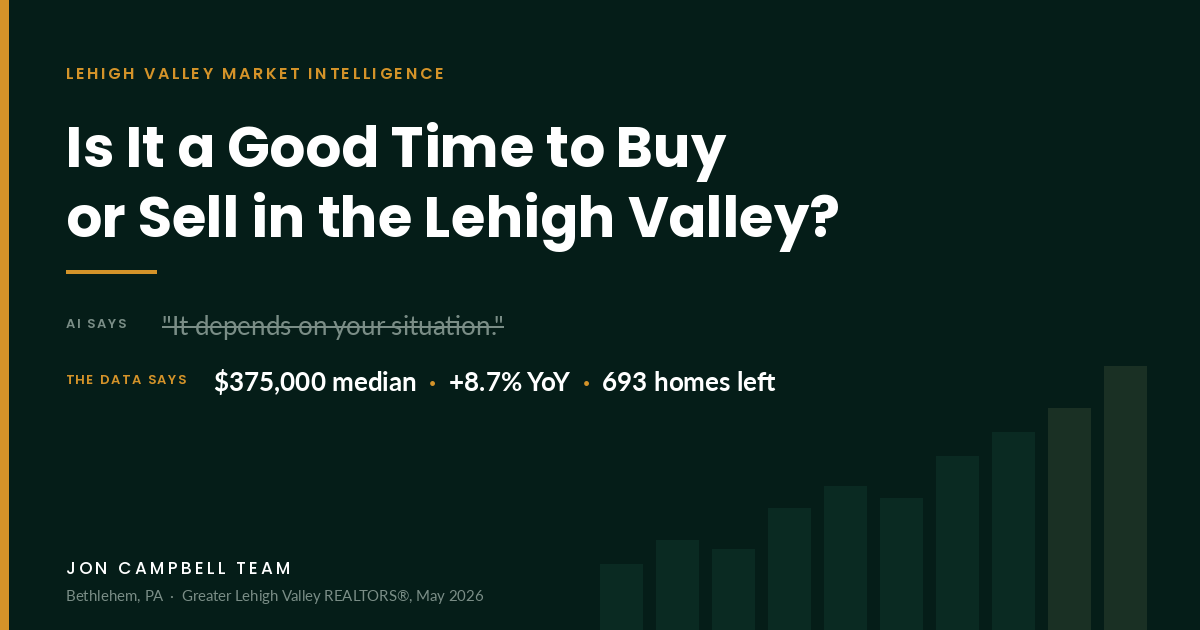
Yes — for most Lehigh Valley buyers and sellers, mid-2026 is a workable market, but for opposite reasons. Sellers hold the advantage: the median sale price hit a record $375,000 in May 2026, up 8.7% year over year, with inventory down 7.7% and homes still selling at roughly list price. Buyers get a rate at 6.49% — lower than a year ago — and less national competition. The wrong question is “is it a good time.” The right question is “what does this market do to my specific plan?”
Ask ChatGPT whether now is a good time to buy a home and it will give you a competent, careful, completely useless answer. It will tell you rates are elevated but off their peak. It will tell you inventory is tight. It will tell you it depends on your financial situation. It will hedge in both directions and then suggest you speak with a local professional.
It is not wrong. It is just not an answer.
The problem is structural. AI models are trained on national data, and national data is an average of markets that behave nothing like each other. Austin and Phoenix are seeing price cuts and sellers competing for buyers. The Lehigh Valley is doing the exact opposite. When you average those two realities together, you get a number that describes neither one — and that average is what the chatbot hands you.
So here is the local picture, with sources, and here is the part the model cannot know.
What the Lehigh Valley market actually looks like right now
The most recent verified data from Greater Lehigh Valley REALTORS® covers May 2026, released June 15. It describes a market that is tight, expensive, and still moving.
Metric
Lehigh Valley (May 2026)
Direction
Median sale price
$375,000 — ties the all-time record
+8.7% year over year
Homes sold
528
−2.4% year over year
Homes available (Lehigh + Northampton)
693 units
−7.7% year over year
New listings
764
−5.3% year over year
Pending sales
659
+4.3% year over year
30-year fixed mortgage rate
6.49% (July 9, 2026)
Down from 6.72% a year ago
U.S. median existing-home price
$417,700
Lehigh Valley is ~$43K below it
Sources: Greater Lehigh Valley REALTORS® May 2026 market report; Freddie Mac Primary Mortgage Market Survey, July 9, 2026; National Association of REALTORS®.
Read those rows together and the story is not ambiguous. Fewer homes came to market. Fewer homes sold. And the price went up anyway, to a record. That only happens when demand is chasing a supply that is not there.
Pending sales rising 4.3% while inventory falls 7.7% is the tell. Buyers did not leave. They are still writing offers — there is simply less to write them on.
Why the national narrative doesn’t apply here
Every AI model has read the same headlines you have: homes are sitting longer, sellers are cutting prices, buyers finally have leverage. Those stories are accurate — about the South and the West. Phoenix, Austin, Tampa, and Dallas built aggressively through the boom and are now absorbing that supply.
The Northeast never built. It is one of the few regions where sellers still hold the advantage and well-presented homes routinely sell at or above asking price. The Lehigh Valley sits inside that exception, and it has a demand driver most of the Northeast does not: New York and North Jersey buyers arriving with equity, priced out of their own markets, looking at a $375,000 median and seeing a bargain.
When a model averages the Sun Belt correction with Northeast scarcity, the Lehigh Valley disappears into the middle. You get “the market is balancing.” It is not balancing here.
What AI gets wrong — line by line
“Wait for rates to drop.”
The model’s logic: rates fall, your payment falls, you win.
What actually happens here: rates dipped to 5.98% in February 2026 — the first sub-6% print in three and a half years. Prices did not fall in response. They hit a record four months later. In a market with 693 homes for sale, every drop in rate releases more buyers into the same tiny pool of inventory, and the price absorbs the savings. Cheaper money in a supply-starved market does not make homes cheaper. It makes them more contested.
“Inventory is tight, so buyers should sit out.”
The model’s logic: less choice, more competition, bad time to buy.
What actually happens here: tight inventory is not a season. It is the structural condition of this market and has been for four years. “Waiting for more choice” in the Lehigh Valley has cost buyers 8.7% in a single year — roughly $30,000 on a median home. There is no version of the next 24 months where 693 units becomes 2,000.
“Sellers should list now while prices peak.”
The model’s logic: sell at the top.
What actually misses: almost every seller here is also a buyer. A record sale price means nothing if you have to turn around and compete for your next home in the same 693 units — with a rate higher than the one you are giving up. The real seller question is not “can I get top dollar.” It is “what is my landing plan, and can I sequence the two transactions without ending up in a rental.” AI does not ask that. It should be the first question anyone asks you.
“It depends on your situation.”
The model’s logic: hedge.
What actually matters: this is the only genuinely correct thing the model says, and it stops exactly where the work begins. Your situation is the whole answer — how long you’ll stay, how stable the income is, whether a school district is non-negotiable, whether there’s a second income coming or leaving, whether you can carry two payments for six weeks. Nobody who hasn’t asked you those questions can tell you what to do.
So: buy, sell, or wait?
The honest framework — the one we use with clients — is three questions long, and none of them is about the market.
Buying makes sense right now if:
You expect to stay in the home at least 5 years. Below that, transaction costs eat appreciation, and no market condition changes that math.
Your payment at 6.49% is comfortable — not survivable, comfortable. If the rate drops, you refinance. If it doesn’t, you’re fine. Never buy on the assumption of a refinance.
You can compete without waiving inspection. Preparation, not aggression, is what wins here.
Selling makes sense right now if:
You have a landing plan — the next home, a rental, a relocation, or family. A record price with nowhere to go is not a win.
Your home shows well or you’re willing to invest in making it show well. The market pays a record price for prepared homes. It is meaningfully less generous to the rest.
You’re moving out of the region or down in price. Those two sellers capture the record without immediately paying it back.
Waiting makes sense if:
Your job or income changes in the next 12 months. That is a real reason. “Rates might drop” is not.
You need 6–12 months to fix credit or build reserves. Buying with no cushion in a 1-to-2-month-supply market is how people get hurt.
Notice that none of those tests reference a headline. That is the point. The market is an input to your decision. It is not the decision.
Where to actually start
If you’re selling: get a real valuation, not an automated estimate. Zillow and Redfin models do not know that your kitchen was redone in 2024, that the roof is four years old, or that the comp two streets over sold with a failed septic. In a market pricing at roughly list, the list price is the strategy.
If you’re buying: get fully underwritten before you look, not pre-qualified. In a market with 693 homes and rising pending sales, the buyer with a verified approval and a clean, flexible timeline wins over the buyer with a slightly higher number and a soft letter. That is not a market opinion. That is what listing agents tell us every week.
Frequently asked questions
Is now a good time to buy a house in the Lehigh Valley?
For buyers planning to stay at least five years, yes. The 30-year fixed rate is 6.49% as of July 9, 2026 — below the 6.72% of a year ago — and Lehigh Valley’s $375,000 median sits about $43,000 under the national median of $417,700. The constraint is inventory, not price: with 693 homes available across Lehigh and Northampton counties, buyers need financing in place before they shop.
Is now a good time to sell a house in the Lehigh Valley?
Yes, if you have a plan for where you’re going. The May 2026 median sale price of $375,000 ties the all-time record, up 8.7% year over year, and inventory fell 7.7%. Sellers who are relocating out of the area, downsizing, or moving to a lower price point capture that record most cleanly. Sellers buying back into the same market should sequence both transactions before listing.
Will home prices drop in the Lehigh Valley in 2026?
There is no current data pointing to a decline. Prices rose 8.7% year over year through May 2026 while inventory fell 7.7% and pending sales rose 4.3%. Price drops require supply to exceed demand; the Lehigh Valley currently has under two months of supply, and six months is considered a balanced market.
Should I wait for mortgage rates to fall before buying?
In a low-inventory market, falling rates typically raise prices rather than lower total cost. Rates dipped to 5.98% in February 2026 and the Lehigh Valley median still hit a record in May. Buyers generally do better locking a home at today’s price and refinancing later if rates improve — you can change your rate, you cannot change your purchase price.
How fast are homes selling in the Lehigh Valley?
Quickly. Well-priced, well-presented homes routinely sell at or near list price, and the region holds under two months of supply. Homes that linger are almost always mispriced or under-prepared rather than unwanted.
Is the Lehigh Valley a buyer’s market or a seller’s market in 2026?
A seller’s market. Inventory is under two months of supply, prices set a record in May 2026, and pending sales are rising. A balanced market is roughly six months of supply.
Get an answer built for your situation, not the national average
We’ll walk your numbers, your timeline, and your street — not a chatbot’s average of 3,000 counties.
Jon Campbell leads the Jon Campbell Team, a Lehigh Valley real estate team based at 95 Highland Ave, Suite 130, Bethlehem, PA 18017. The team serves buyers and sellers across Lehigh and Northampton counties, including Bethlehem, Allentown, Easton, Emmaus, Macungie, Nazareth, and the Saucon Valley. Market data in this article is drawn from Greater Lehigh Valley REALTORS® and Freddie Mac and is updated as new reports are released. Reach the team at 610-756-2090.
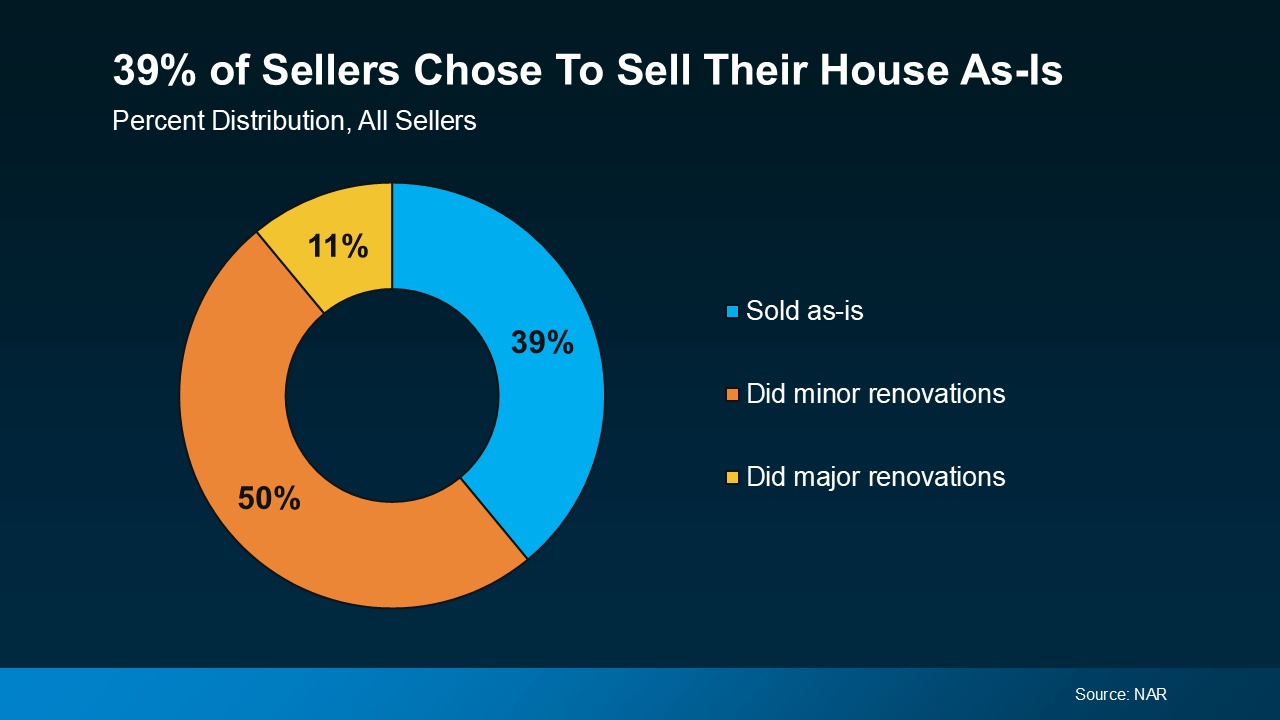
A recent study from the National Association of Realtors (NAR) shows most sellers (61%) completed at least minor repairs when selling their house. But sometimes life gets in the way and that’s just not possible. Maybe that’s why, 39% of sellers chose to sell as-is instead (see chart below):
If you’re feeling stressed because you don’t have the time, budget, or resources to tackle any repairs or updates, you may be tempted to sell your house as-is, too. But before you decide to go this route, here’s what you need to know.
What Does Selling As-Is Really Mean?
Selling as-is means you won’t make any repairs before the sale, and you won’t negotiate fixes after a buyer’s inspection. And this sends a signal to potential buyers that what they see is what they get.
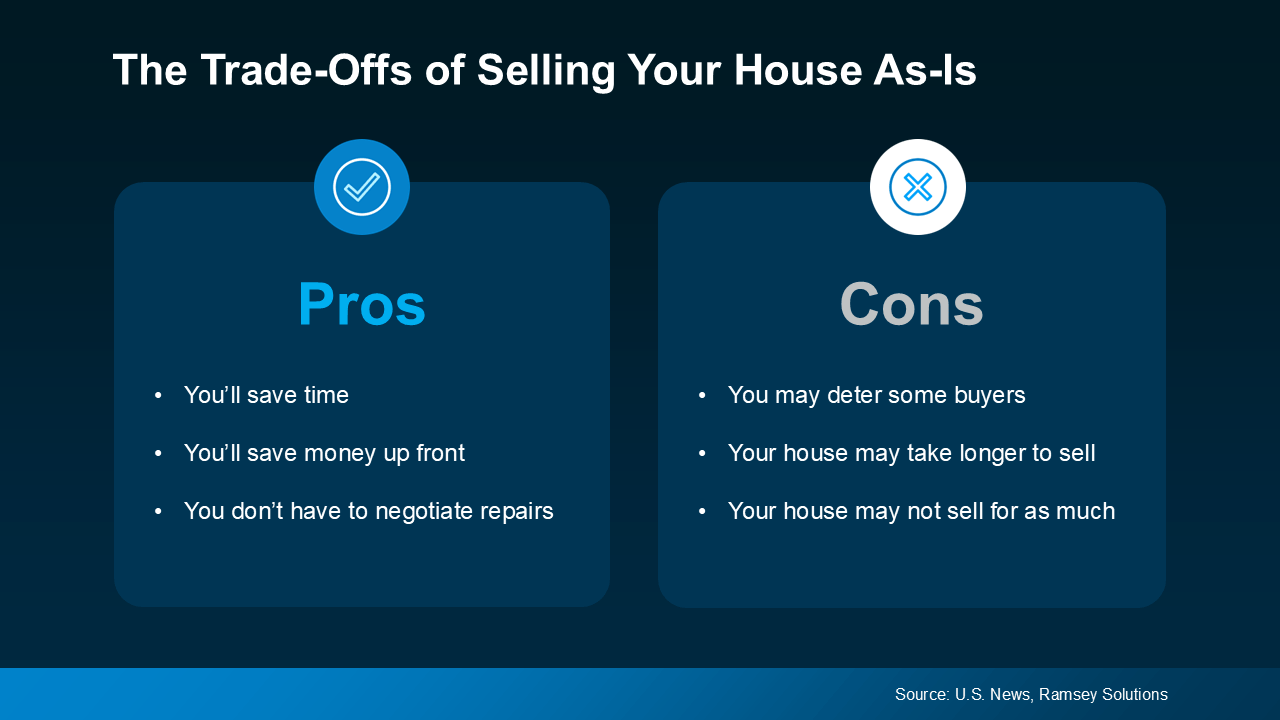
If you’re eager to sell but money or time is tight, this can be a relief because it’s that much less you’ll have to worry about. But there are a few trade-offs you’ll have to be willing to make. This visual breaks down some of the pros and cons:
Typically, a home that’s updated sells for more because buyers are often willing to pay a premium for something that’s move-in ready. That’s why you may find not as many buyers will look at your house if you sell it in its current condition. And less interest from buyers could mean fewer offers, taking longer to sell, and ultimately, a lower price. Basically, while it’s easier for you, the final sale price might be less than you’d get if you invested in repairs and upgrades.
That doesn’t mean your house won’t sell – it just means it may not sell for as much as it would in top condition.
Here’s the good news though. In today’s market, as many as 56% of buyers surveyed would be willing to buy a home that needs some work. That’s because affordability is still a challenge, and while there are more homes for sale right now, inventory is lower than the norm. So, you might find there are a few more buyers who may be willing to take on the work themselves.
How an Agent Can Help
So, how do you make sure you’re making the right decision for your move? The key is working with a pro.
A good agent will help you weigh your options by showing you what comparable homes in your area have sold for, what updates your neighbors are making, and guide you in setting a fair price no matter what you decide. That helps you anticipate what your house may sell for either way – and that can be a key factor in your final decision.
Once you’ve picked which route you’re going to go and the asking price is set, your agent will market your house to maximize its appeal. And if you decide to sell as-is, they’ll call attention to the best features, like the location, size, and more, so it’s easy for buyers to see the potential, not just projects.
Bottom Line
Selling a home without making any repairs is possible in today’s market, but it does have some trade-offs. To make sure you’re considering all your options and making the best choice possible, let’s have a conversation.
Allison and James F. are DLP Realty’s first recipients of the company’s Holiday Offer with the Immediate Buyout Program. During the month of December, DLP Realty will buy your home (as is), plus give you a $5,000 gift card at closing! The IBO is the company’s longest-running homeselling solution, offering a competitive price for your home without the hassle of costly home improvements and cleanups, scheduled showings, and all those extra closing costs.
Allison and James originally listed their updated and well-maintained Nazareth home with DLP Realty Listing Agent Cindy Lou Lapp. It didn’t take long before they had offers, but unfortunately they experienced not one but two deals that fell through and they were back to square one, relisting and scheduling more showings.
Soon after relisting again, the couple found the one-level home they were looking for, a 3-bedroom detached ranch in the Lehigh Valley. Not wanting to risk losing out on this new home, they decided to sign-up for the IBO which gave them not only cash in hand and piece of mind, but also the ability to buy their next home. And, with the holiday offer, they’d receive an additional $5,000 gift card toward whatever they wanted, a nice extra during the holiday season.
Cindy says, “After the second deal fell through, I knew Allison and James were growing weary of dealing with new buyers and all of the hassle. Selling your home is extremely time-consuming and stressful. When they found their next ideal home, they were afraid of losing out. The IBO really does solve the Catch-22 of real estate.”