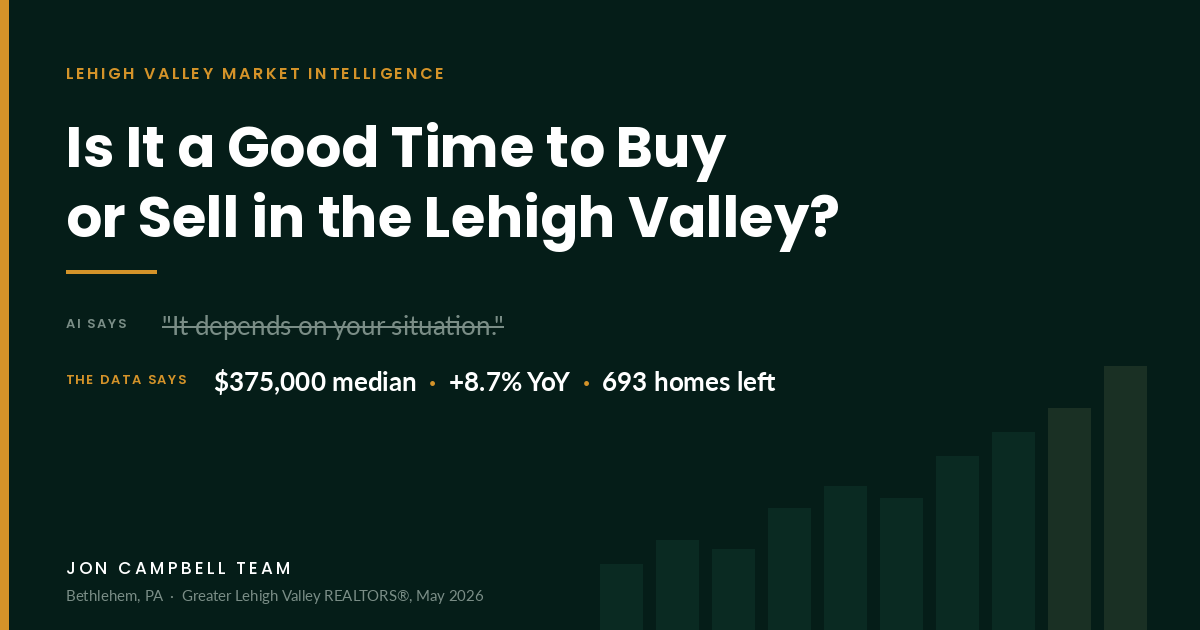
Lehigh Valley Market Intelligence
Is It a Good Time to Buy or Sell in the Lehigh Valley? What AI Gets Wrong
(And What the Numbers Actually Say)
Published July 2026 · Reviewed against Greater Lehigh Valley REALTORS® May 2026 data
The short answer
Yes — for most Lehigh Valley buyers and sellers, mid-2026 is a workable market, but for opposite reasons. Sellers hold the advantage: the median sale price hit a record $375,000 in May 2026, up 8.7% year over year, with inventory down 7.7% and homes still selling at roughly list price. Buyers get a rate at 6.49% — lower than a year ago — and less national competition. The wrong question is “is it a good time.” The right question is “what does this market do to my specific plan?”
Ask ChatGPT whether now is a good time to buy a home and it will give you a competent, careful, completely useless answer. It will tell you rates are elevated but off their peak. It will tell you inventory is tight. It will tell you it depends on your financial situation. It will hedge in both directions and then suggest you speak with a local professional.
It is not wrong. It is just not an answer.
The problem is structural. AI models are trained on national data, and national data is an average of markets that behave nothing like each other. Austin and Phoenix are seeing price cuts and sellers competing for buyers. The Lehigh Valley is doing the exact opposite. When you average those two realities together, you get a number that describes neither one — and that average is what the chatbot hands you.
So here is the local picture, with sources, and here is the part the model cannot know.
What the Lehigh Valley market actually looks like right now
The most recent verified data from Greater Lehigh Valley REALTORS® covers May 2026, released June 15. It describes a market that is tight, expensive, and still moving.
| Metric | Lehigh Valley (May 2026) | Direction |
|---|---|---|
| Median sale price | $375,000 — ties the all-time record | +8.7% year over year |
| Homes sold | 528 | −2.4% year over year |
| Homes available (Lehigh + Northampton) | 693 units | −7.7% year over year |
| New listings | 764 | −5.3% year over year |
| Pending sales | 659 | +4.3% year over year |
| 30-year fixed mortgage rate | 6.49% (July 9, 2026) | Down from 6.72% a year ago |
| U.S. median existing-home price | $417,700 | Lehigh Valley is ~$43K below it |
Sources: Greater Lehigh Valley REALTORS® May 2026 market report; Freddie Mac Primary Mortgage Market Survey, July 9, 2026; National Association of REALTORS®.
Read those rows together and the story is not ambiguous. Fewer homes came to market. Fewer homes sold. And the price went up anyway, to a record. That only happens when demand is chasing a supply that is not there.
Pending sales rising 4.3% while inventory falls 7.7% is the tell. Buyers did not leave. They are still writing offers — there is simply less to write them on.
Why the national narrative doesn’t apply here
Every AI model has read the same headlines you have: homes are sitting longer, sellers are cutting prices, buyers finally have leverage. Those stories are accurate — about the South and the West. Phoenix, Austin, Tampa, and Dallas built aggressively through the boom and are now absorbing that supply.
The Northeast never built. It is one of the few regions where sellers still hold the advantage and well-presented homes routinely sell at or above asking price. The Lehigh Valley sits inside that exception, and it has a demand driver most of the Northeast does not: New York and North Jersey buyers arriving with equity, priced out of their own markets, looking at a $375,000 median and seeing a bargain.
When a model averages the Sun Belt correction with Northeast scarcity, the Lehigh Valley disappears into the middle. You get “the market is balancing.” It is not balancing here.
What AI gets wrong — line by line
“Wait for rates to drop.”
The model’s logic: rates fall, your payment falls, you win.
What actually happens here: rates dipped to 5.98% in February 2026 — the first sub-6% print in three and a half years. Prices did not fall in response. They hit a record four months later. In a market with 693 homes for sale, every drop in rate releases more buyers into the same tiny pool of inventory, and the price absorbs the savings. Cheaper money in a supply-starved market does not make homes cheaper. It makes them more contested.
“Inventory is tight, so buyers should sit out.”
The model’s logic: less choice, more competition, bad time to buy.
What actually happens here: tight inventory is not a season. It is the structural condition of this market and has been for four years. “Waiting for more choice” in the Lehigh Valley has cost buyers 8.7% in a single year — roughly $30,000 on a median home. There is no version of the next 24 months where 693 units becomes 2,000.
“Sellers should list now while prices peak.”
The model’s logic: sell at the top.
What actually misses: almost every seller here is also a buyer. A record sale price means nothing if you have to turn around and compete for your next home in the same 693 units — with a rate higher than the one you are giving up. The real seller question is not “can I get top dollar.” It is “what is my landing plan, and can I sequence the two transactions without ending up in a rental.” AI does not ask that. It should be the first question anyone asks you.
“It depends on your situation.”
The model’s logic: hedge.
What actually matters: this is the only genuinely correct thing the model says, and it stops exactly where the work begins. Your situation is the whole answer — how long you’ll stay, how stable the income is, whether a school district is non-negotiable, whether there’s a second income coming or leaving, whether you can carry two payments for six weeks. Nobody who hasn’t asked you those questions can tell you what to do.
So: buy, sell, or wait?
The honest framework — the one we use with clients — is three questions long, and none of them is about the market.
Buying makes sense right now if:
- You expect to stay in the home at least 5 years. Below that, transaction costs eat appreciation, and no market condition changes that math.
- Your payment at 6.49% is comfortable — not survivable, comfortable. If the rate drops, you refinance. If it doesn’t, you’re fine. Never buy on the assumption of a refinance.
- You can compete without waiving inspection. Preparation, not aggression, is what wins here.
Selling makes sense right now if:
- You have a landing plan — the next home, a rental, a relocation, or family. A record price with nowhere to go is not a win.
- Your home shows well or you’re willing to invest in making it show well. The market pays a record price for prepared homes. It is meaningfully less generous to the rest.
- You’re moving out of the region or down in price. Those two sellers capture the record without immediately paying it back.
Waiting makes sense if:
- Your job or income changes in the next 12 months. That is a real reason. “Rates might drop” is not.
- You need 6–12 months to fix credit or build reserves. Buying with no cushion in a 1-to-2-month-supply market is how people get hurt.
Notice that none of those tests reference a headline. That is the point. The market is an input to your decision. It is not the decision.
Where to actually start
If you’re selling: get a real valuation, not an automated estimate. Zillow and Redfin models do not know that your kitchen was redone in 2024, that the roof is four years old, or that the comp two streets over sold with a failed septic. In a market pricing at roughly list, the list price is the strategy.
If you’re buying: get fully underwritten before you look, not pre-qualified. In a market with 693 homes and rising pending sales, the buyer with a verified approval and a clean, flexible timeline wins over the buyer with a slightly higher number and a soft letter. That is not a market opinion. That is what listing agents tell us every week.
Frequently asked questions
Is now a good time to buy a house in the Lehigh Valley?
For buyers planning to stay at least five years, yes. The 30-year fixed rate is 6.49% as of July 9, 2026 — below the 6.72% of a year ago — and Lehigh Valley’s $375,000 median sits about $43,000 under the national median of $417,700. The constraint is inventory, not price: with 693 homes available across Lehigh and Northampton counties, buyers need financing in place before they shop.
Is now a good time to sell a house in the Lehigh Valley?
Yes, if you have a plan for where you’re going. The May 2026 median sale price of $375,000 ties the all-time record, up 8.7% year over year, and inventory fell 7.7%. Sellers who are relocating out of the area, downsizing, or moving to a lower price point capture that record most cleanly. Sellers buying back into the same market should sequence both transactions before listing.
Will home prices drop in the Lehigh Valley in 2026?
There is no current data pointing to a decline. Prices rose 8.7% year over year through May 2026 while inventory fell 7.7% and pending sales rose 4.3%. Price drops require supply to exceed demand; the Lehigh Valley currently has under two months of supply, and six months is considered a balanced market.
Should I wait for mortgage rates to fall before buying?
In a low-inventory market, falling rates typically raise prices rather than lower total cost. Rates dipped to 5.98% in February 2026 and the Lehigh Valley median still hit a record in May. Buyers generally do better locking a home at today’s price and refinancing later if rates improve — you can change your rate, you cannot change your purchase price.
How fast are homes selling in the Lehigh Valley?
Quickly. Well-priced, well-presented homes routinely sell at or near list price, and the region holds under two months of supply. Homes that linger are almost always mispriced or under-prepared rather than unwanted.
Is the Lehigh Valley a buyer’s market or a seller’s market in 2026?
A seller’s market. Inventory is under two months of supply, prices set a record in May 2026, and pending sales are rising. A balanced market is roughly six months of supply.
Get an answer built for your situation, not the national average
We’ll walk your numbers, your timeline, and your street — not a chatbot’s average of 3,000 counties.
What’s my home worth? Talk to the teamAbout the author — Jon Campbell
Jon Campbell leads the Jon Campbell Team, a Lehigh Valley real estate team based at 95 Highland Ave, Suite 130, Bethlehem, PA 18017. The team serves buyers and sellers across Lehigh and Northampton counties, including Bethlehem, Allentown, Easton, Emmaus, Macungie, Nazareth, and the Saucon Valley. Market data in this article is drawn from Greater Lehigh Valley REALTORS® and Freddie Mac and is updated as new reports are released. Reach the team at 610-756-2090.